Your kids are doing better than their end of year test allows them to be labeled. Both you and your kid need to know this. The deck is stacked against students in demonstrating their success because nearly all standardized educational testing is built around a curve designed to knock kids down rather than lift them... Continue Reading →
Sniping at students to sell vouchers – Bursting the Bubble Sheet part 3
When many students show growth, it should be celebrated. If all students show growth, they should have an opportunity to be acknowledged as growing. So why does North Carolina use a contracted formula originally used in agriculture to plow public school student performance with misleading data? The system is not designed to label all students... Continue Reading →
Private school vouchers serve adults, not children
Last year, Republicans in the General Assembly eliminated an income cap as an eligibility requirement to receive a private school voucher. This decision alone will funnel millions of dollars away from helping public schools in low-income communities and into the hands of wealthy families who never even considered sending their children to their community’s public... Continue Reading →
Bursting the Bubble Sheet Part 2: Seeing the forest before the trees
For part 2 of this Bursting the Bubble Sheet series, I’m going to zoom out to ensure I’m clearly communicating the forest of this project before diving into each tree: There’s an unfortunate fact pattern where deceptively portrayed K-12 data is being used to undermine communities’ faith in their local public schools as a marketing... Continue Reading →
Bursting the Bubble Sheet: NC DPI’s Disingenuous Claims on K-12 Testing Data Part 1
Preface: Over a decade ago Rhett Carlson, a high school science teacher, reverse-engineered EVAAS - a K-12 test data translation tool created by NC-based analytics company SAS and used by the NC Department of Public Instruction. This program is modeled after one that was used in agriculture to increase plant growth and cull dairy herds... Continue Reading →
NC’s Name Games: 4 things to know
Earlier this month, the NC General Assembly overrode Gov. Roy Cooper's veto to make S49 law. Among other things, this law requires the following: As a teacher tasked with implementing this law in my classroom and a mom of 2 schoolchildren, I was sincerely interested in proactively navigating how the "naming clause" would impact my... Continue Reading →
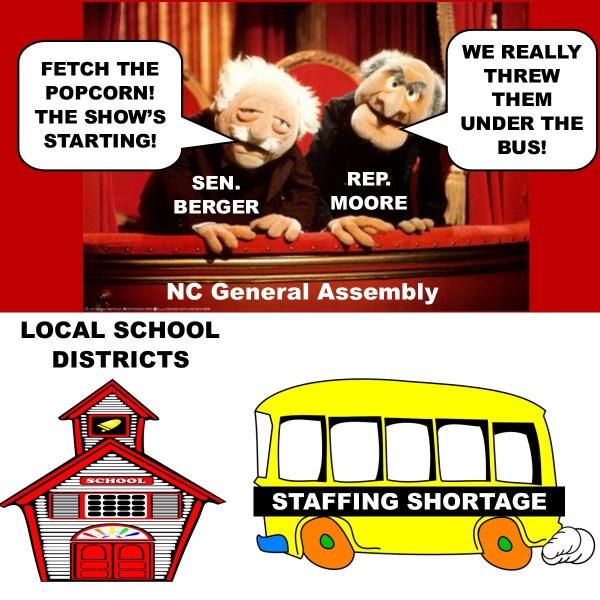
Why might your kid not have a bus driver or teacher this year? Remember NCGA leaders admit they don’t want to compete for staff.
At yesterday's WCPSS school board meeting, it was shared that some middle and high school students may only receive regular school transportation on an A/B every other week basis because there are 17 bus driver vacancies. While many folks' knee-jerk reaction is to assume this is a local problem with local deficits needing a solution... Continue Reading →
5 proposed changes to parenting and teaching in North Carolina
Today the NC General Assembly published a proposal that would make changes to parenting and teaching in North Carolina. You can read the full text here. There's a lot of nonsense in this proposal, but here are 5 items that most jumped out to me after a first round of notes. 1. Create another curriculum... Continue Reading →
Many NCGA lawmakers use a preferred name. Why can’t students use theirs?
A bill making its way through the NC General Assembly seeks in part to make the first day of school more nerve-racking by requiring parent notification before a school staff member may address a student by any altered name. From SB 49 "Parents' Bill of Rights" My student rosters after Day 1 are full of... Continue Reading →
NC Student Tax: $137,000 per classroom
Yesterday I watched my students cross the stage to receive their diplomas and listened to speeches recognizing the unique challenges they faced during the pandemic. I couldn't help but think about a less unique but deeper and more lingering crisis faced by previous classes and set to continue unless more NC residents recognize the problem... Continue Reading →